


AP064 » SEGREGATION OF DOMESTIC GARBAGE WASTE USING EMBEDDED SYSTEM
The rapid growth of population and urbanization has resulted in increasing the volume of solid waste generation in the study area in particular and in India with 68.8 million tons/day. The improper disposal of solid waste becomes a major menace to the urban area and their surroundings. The management of Municipal Solid Waste (MSW) has become an acute problem to the society due to the enhancement of economic activities and modernization. The composition of MSW is 51 % organic, 17.5 % recyclables (paper, plastic, metal, and glass). The composition of MSW in the North, East, South and Western regions of the country varied between 50 and 57 % of organics, 16–19 % of recyclables, 28–31 % of inserts and 45–51 % of moisture. The segregation, handling, transport, and disposal of waste are to be properly managed so as to minimize the risk to the health and safety of patients, the public, and the environment. .The economic value of waste is best realized when it is segregated. This project proposes to segregate the Bio-degradable and Non-Bio-degradable at the household level.Bio-degradable waste includes organic waste i.e Kitchen waste and Vegetable waste. Non-bio-degradable waste can be further segregated into Recyclable Waste, Toxic waste, and soiled waste. The benefits of doing so are that a higher quality of the material is retained for recycling which means more value could be recovered from waste. this project proposes to segregate the Bio-degradable and Non-Bio-degradable at the household level. The level of the garbage collected in the container is monitored using sensors.The information is stored in cloud storage and sent to the zonal area server room and the intimation is sent to the Garbage collection vehicle to collect the waste.
Introduction:
Nowadays, garbage disposal has become a major concern all over the world. The common method of disposal of the waste is by unplanned and uncontrolled open dumbing at the landfill sites. This method is injurious to human health, plant and animal life. Door to Door collection of waste is the method of segregation, but is not a common practice in India except in the metro cities, where some private organizations are doing such work. Rag pickers play an important role in the recycling of urban solid waste, while they segregate the waste in the streams such us Biodegradable waste and Non-Bio-degradable waste. Bio-degradable waste includes organic waste i.e Kitchen waste and Vegetable waste and Non-bio-degradable waste can be further segregated into recyclable waste, toxic waste, and soil waste. The important benefit is that high quality material is retained for recycling, which means more value could be recovered from waste. The prime need of a smart life cycle begins with cleanliness. The waste can be dispatched properly only if the dustbin is placed well and collected well, taken in account the waste management disposal prevails a major problem in our country. Here, we have designed a new model for the household dustbin. The purpose of this project is the realization of a compact, user-friendly low-cost segregation system for household. Whenever the waste bin gets filled, the information reaches the Google cloud and notified to the Zonal system. Then the wastage dumped place in that area is spotted using the received signal and its status is monitored and controlled.
Design Methodology
In our design, we have divided the overall system into four components: The Bio-degradable and Non-Bio-degradable sensor unit, separate container unit, cloud storage and zonal server.
Working:
The container unit consists of automatic open and close lid, Bio-degradable controller and Non Bio-degradable controller etc.. The automatic open and close lid scans the garbage entering in the dust bin. Then, the garbage is passed to the controller. If the garbage is bio-degradable, then the controller pass the content to the container. If the garbage is Non Bio-degradable, then it is classified as metals and non-metals waste and both are send to another separate container. The containers levels are monitored using sensors, once the containers are fully filled the notification is send to the Amogaa cloud server and the garbage storing data is also stored. Notification signal is passed to the zonal monitoring room and to the garbage collecting vehicle. The vehicle collects those garbage to the recycle process (pyrolysis) mechanism. Continuous monitoring of the garbage level in the container helps us to check if the worker is doing the job efficiently.
Result:
The sensor in the container detects the level of the garbage collected in the container. The garbage level in the container is displayed at the zone monitoring room. Particular user and the monitoring technicians can monitor the level of separated waste in the dustbin.
Conclusion
Due to the unplanned and uncontrolled collection of garbage in the area by the garbage collecting person, the corporation people finds difficult to collect the waste from that area. Our project have more advantages to collect the garbage and segregation process in house hold itself. Thus, by using this process there is no need to make a huge recycle process plant outside the city. The system is an efficient step towards cleanliness.As it being said that the technology which goes parallel with environment is the need of the hour. Our project goes toward Swachh Bharat (clean India) according to our PM.
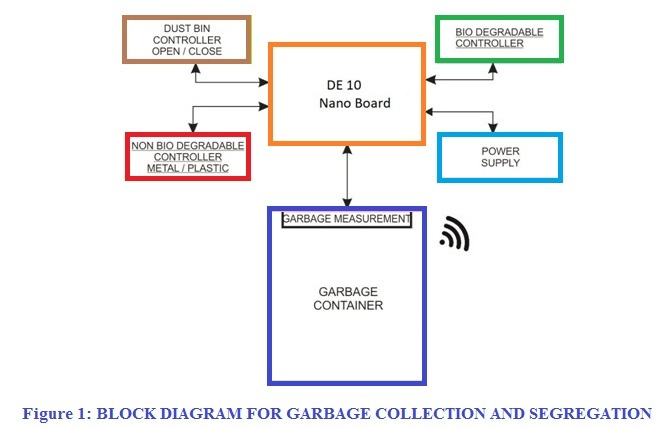
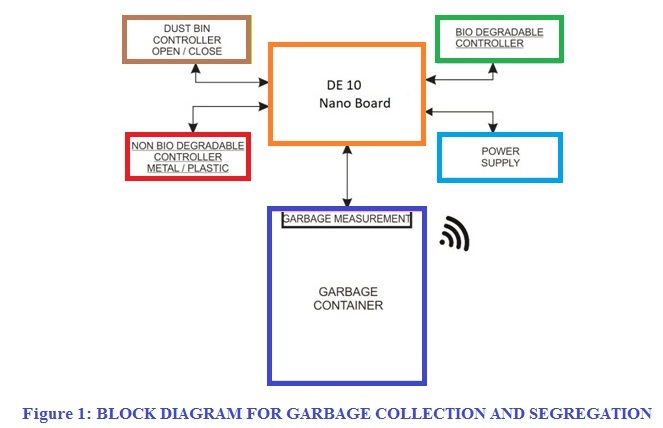
The Intel SoC FPGA device is well suited for this particular application. The Cyclone V SoCs are low cost devices, which improves the ability to widely distribute the production version of the system. The low power can allow for a convenient battery source for the device.
Furthermore, as the proposed project involves signal processing, the use of the FPGA capabilities of the SoC allows for the implementation of this processing in a low power way compared to CPU.
While, it is not envisioned that there will be a large CPU load, the presence of the dual-core ARM processor will allow for upgradability and the use of standard libraries for most software used in the project.
The inclusion of the Dustbin lid controller and Non-bio-degradable controller on the development board will help to demonstrate the breathing rate monitoring functionality. The input/output capabilities of the SoC will also help with interfacing with electrodes and other peripherals.